Denis Merkulov – Russian No. 5: how padel is developing in the regions | Interview
Denis Merkulov – Russian No. 5: How Padel is Developing in the Regions | Interview
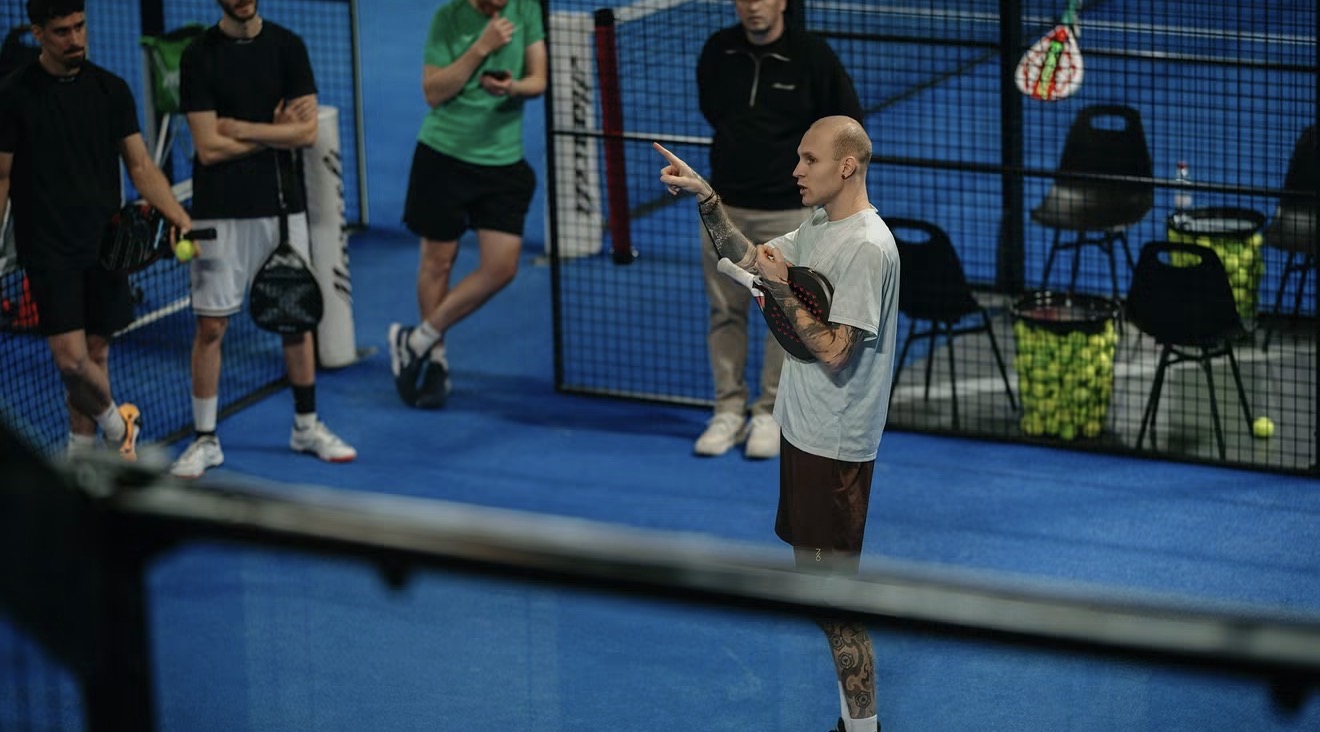
Denis Merkulov is Russia's No. 5 padel player. In this interview, we discussed a new stage in his sporting career: the reasons for leaving the Lunda team, independent promotion alongside his representative, and ambitious plans for the future. A separate topic of conversation was the development of padel in the regions. Denis travels extensively across the country, hosts masterclasses, introduces players to modern training processes, and helps popularise the sport far beyond Moscow.
Viktoria: Denis, tell us, please: we asked a little bit about you, you told us a little bit, everyone is very curious. Can you give us some insider information so everyone has even more to gossip about, or are we keeping it all a little secret for now? What happened, why did you leave (Lunda)?
Denis: As I said, I don't have any issues with the team, with the coaches, with specific people. As everywhere, when a certain moment arrives, I think misunderstandings arise, and each person has their own vision of how to realise what they want to achieve or do there. I think we simply didn't see eye to eye here.
I don't want to speak badly, anxiously, or anything like that. Everything happened here over a certain period of time. A person evolves; every year they develop new thoughts, new desires, what they want to do in their life. Moreover, other interests also emerge, as well as an understanding and a vision of how this can unfold in the process.
Therefore, as I say, it's a normal part of things that people may disagree with certain opinions and certain conclusions. That's why, as I say, I don't want to say anything bad about the club and so on. Maybe someday in the distant future I'll say something more candid, but right now I don't have any inclination to put anyone down, nor is there any need for it.
Besides, it wouldn't be the best look. After all, I spent three years at this club from the very beginning, when we were putting the team together, when the courts were completely empty. Then, thanks to the results of our team and our players, let's say, people started coming. So, in fact, it was a massive effort from both the players and the club.
In other words, we all did a good job here, and I have very warm memories and feelings towards the guys, and not just the guys on the team, as I said, but also the administrators, just the people, and everyone in general who came to Lunda. So at this moment, I don't want to say anything bad.
Viktoria: Just as a certain stage of development, right?
Denis: A certain stage, a certain part of development, and I think that time comes for everyone when either you move forward or you step back.
Viktoria: You know I couldn't not ask. Just in case you were in the mood, you know: "Let me open up a bit."
Denis: Not quite fully just yet.
Viktoria: Agreed. Nor should you; having worked in the corporate environment for so many years myself, you know, my field being linked to B2B. I think that when you remain in the same market niche, there's generally no point saying anything unless you're planning to leave that market.
Because otherwise you create a negative background for yourself; some want to develop on hype, some don't.
Denis: As you rightly said, there is different hype. There is dark hype, black hype, while someone moves on a different kind of hype, and some people don't need it at all.
We simply move forward organically, without negativity.
Viktoria: Moving organically towards the regions. I liked that idea so much! Somewhere in the middle of summer I was also thinking about the regions. We collaborate with Artem Kiselev, I cover his tournaments. I really liked this idea of the 500–750 series, and now there will also be a 1000. Will you be playing?
Denis: I will be playing the 1000, yes.
Viktoria: Absolutely super. And as all of this was being done, it became so interesting to me that we need to highlight the regions. I was in Nizhny Novgorod, in Saratov. Yekaterinburg, it lives a life of its own here. Good on them there. Where else were we? I didn’t make it to Kazan, unfortunately. But everywhere, in every city there is, say, at least one club that tries to host RPF events and so on. But from the guys I hear that there are not enough players, not enough experienced players, and they themselves suffer greatly from this, because the desire is there, but not the opportunity.
Perhaps you have more information about the regions? Tell us, share it, because I know that owners, naturally, invite other players from a commercial point of view. Because, look, we [the owners] have completed courses or training, come learn from us.
But it is also a big plus for the players. What information do you have about the regions? And, by the way, tell us, where are you going?
Denis: After my departure from Lunda, I travelled to Smolensk. Now I am going to Naberezhnye Chelny. Then I will be in Ufa, where the RPT actually took place at Arena Padel Club. Next week I’m going to Go Padel in Yaroslavl. I’ll be there for two days. Then to Kirov. And further on, the rest of the plans and cities too.
In fact, that's completely right, the current situation is that the strong cities are precisely Moscow and Saint Petersburg. As you also rightly noted, Yekaterinburg is a separate entity, a separate infrastructure. And I believe we shouldn't stop there.
I also have the format of trips and masterclasses, but that is not only for coaches, but generally just for everyone.
Viktoria: Ah, so amateurs can also come to a training session?
Denis: Amateurs can come. That is, it's open for people of completely different levels. And on the contrary, it's great. Why did you just mention experienced players? For you to have an experienced player, first an experienced coach needs to visit you. And from that, precisely a certain knowledge base is formed. What a person can give you and what they can absorb. And conversely, it's great that the regions are now bringing in players, because players are not just focusing on staying in Russia right now.
For example, we travelled to Spain. Over the course of three years we travelled to Dubai, to Spain. That is, we played FIP tournaments and gained knowledge everywhere. We worked with various specialists. So with me, in this format, I like to teach in a more live manner, not something strictly scripted where you have set content, but to actually listen to the person, see what is happening with them. And precisely break down all these mistakes.
And precisely to correct technical aspects, positional play, movement. Because anyway, if you look at Russia, all the players are former tennis players. Yes, and even say, when we travelled to Valencia to train, the footwork is different.
And you feel that immediately as well. And this general physical conditioning really helps a lot. So overall, it is about this transfer of knowledge. And I really want to pass on knowledge with high quality, to listen to each person and provide maximum information. Yes, and exactly as I said, so that not only coaches come, not only players, but just people in general. So that they also get some sort of idea of how to train, how to improve in this aspect.
That is why I want to travel in this format right now, I want to talk, listen to people and understand what problems they are facing in the first place. Because we might see the situation from one perspective, but we also need to hear about their situation, what they are lacking, for instance. For example, I travelled to Vladivostok this year too. Now Danya Kholodov, for instance, travels there often as well. That is, they also understand that right now they need a specialist, for instance, to bring up their guys, their coaches, so that these coaches can pass on quality knowledge to their clients, their players. And that is exactly how this routine works.
Of course, some people do not like travelling, but I [do], I have been travelling all my life. And I do not like staying in one place for long. I get bored.
That is, I always want to see something new for myself. And even more so if I can combine business with pleasure, that is a double bonus for me. Something like that.
Viktoria: Great. And which city do you think is promising today, but lacks knowledge? Do you have any in mind? Where you think these guys are doing well, coming to play, but you would like to see better? Because there was the Interregional Cup recently, guys came along, those who follow it watched and generally assessed how it all works.
Denis: You always want to see the young, upcoming generation. You were at the Interregional Cup too. Which region was it for you?
Viktoria: Kirov Region. For some reason, it caught my eye.
Denis: I will go to Kirov, for example. Of course, I would like to see young guys there. That is precisely where the future will come from. If there is a direction, starting at least with juniors. The guys often bring joy, like the Eliseev brothers, for example.
Viktoria: They really do. They do not bring joy to the ones they beat. Some people get really angry.
Denis: That is normal. Two years ago, I also said that I would only be happy. Of course, I will not like being beaten, but on the other hand, it is great that people are developing and the standard is getting higher and higher. And you have to be ready for that, and you have to take it well. If you get beaten, well, then you have to pull yourself together and understand that, right, you need to work on your mistakes.
And on the contrary, it is great when there is such competition, when there is such competence, and that there are guys who beat you. Good, that means you need to work on exactly that. But here the whole snag lies in where these people are based. For instance, the Eliseev brothers train here in Moscow. But from what I see, they really bring a lot of joy.
Especially the national team matches that they played. We also played friendly sets with them amongst the team. What they are doing right now, they are playing smartly; besides that, they have a very good connection as brothers. A mental one. In fact, cases vary, but this is precisely one of those cases where the brothers have connected well with each other. The most important thing is not to fall out.
Therefore, regarding the regions... You asked a good question. For instance, I travelled to Vladivostok, I saw a few guys there. Yes, they are around my age, but as for the really, really young ones. Probably what you said, in the Kirov Region, yes, in that part. If I see them in Kirov, it would be great to pass on this knowledge to them.
Viktoria: I heard from the guys that a lad moved to Lunda, his name is Samat.
Denis: Yes, Samat Zakirov.
Viktoria: Yes, I adore Samatik, simply an absolute gem. He moved from Kazan, if I'm not mistaken?
Denis: That's right, yes.
Viktoria: And his partner [Robert Galiullin], who played with him. Just recently they won a 250 tournament, in August, I think, if I'm not mistaken. He is feeling down. And he says that he is all alone in Kazan, that there is no one to even feed balls from a basket with. Is that really so? Is Kazan really that weak, or does he just miss Samatik so much?
Denis: By the way, you have just answered the question. I know that there are 5–6 young lads based in Kazan. Yes, and regarding Samat, I will speak on his behalf here as well, probably. At a certain point, I really wanted him to join Lunda back then, because from the outside I somehow saw the potential, and in fact he reminded me a bit of myself. Tall, a bit of an octopus, and I like his shots, and overall his mentality, the fact that this is precisely what he wants.
Overall, a wonderful lad, and young. As I say, padel is changing too. And when you already have good height, good physical attributes, and good shots, it can be seen. But now everything depends solely on him. He has landed in good hands now, and I only hope for him to truly flourish.
In Kazan, yes, there is possibly such a problem. I haven't been to Kazan in a long time, not since the RPT tournament. Right now, as I've said, the strongest base we have is Moscow and Saint Petersburg. Yes, that is what we are arriving at now, there are players, which is why I took up this matter as well, promoting the regions.
That is to say, even if these are masterclasses, I want to see what is genuinely happening there. And, of course, it is also in the club’s own interest, because if a club wants progression for its players there, it must, of course, invite an experienced specialist. And this is a logical, let's say, story, because they have their own idea of how to run the process, whereas here is a person who already has processed information and can set things up differently. Therefore, I think everything here also depends on the club's target point, in which direction it is moving. Whether it is moving only in the commercial aspect, yes, or moving specifically along the sports pathway. If it's the sports pathway, of course, the guys should sort of be invited there more, gathering like-minded people around them who will come there and train.
I wouldn't want it to be only Moscow, Saint Petersburg, Yekaterinburg. That is, it would be great for experienced specialists to gradually appear in the regions too, and for them to be promoted.
Viktoriya: Well, yes. In Nizhny Novgorod, we spoke with the head. If I'm not mistaken, an RPF event was held just recently at the Zhar-Ptitsa SEC. And we were talking about how there's also a lack of experience. They train their own coaches, they try, they bring in guys from Moscow, inviting them to come and pass on their experience. Now I'll try to phrase my question diplomatically. There are no doubts about you, absolutely, as a specialist, because you are a very experienced player and you've proved it both with your ranking and your matches. It's really great to watch. I always support you and Vitya [Baluda] when I watch you play. Truly, you really are my favourites. But there are coaches who might be freeloading; they live in Moscow, you know, and they can go there simply because they are from Moscow. How do you feel about this, or is it just the market being the market?
Denis: In fact, I view this very negatively. Overall, in general, because the story of coaches coming in... For example, even I, as a former tennis player, love tennis very much. That is, I can still even watch some matches. But I haven't picked up a tennis racket.
Viktoriya: In a long time?
Denis: Yes, a long time, three years now. Exactly, since the beginning of '23.
Viktoriya: Doesn't it miss you lying at home?
Denis: No. For me, padel is genuinely a second wind of inspiration. And precisely the desire to develop all of this. Initially, that was the goal.
I don't like coaches who come in – and I've seen this repeatedly – when they coach the tennis way, who position themselves as knowing everything better, and who don't want to, let's say, at least take a specific course, even from our federation, to have some understanding. And, of course, all the same, this sport is young in Russia. Last year it began developing even more; that is, in Moscow, if you count, we already have more than 70 clubs. Even more clubs are appearing everywhere. They open every month. And since it's a young sport, naturally, you know, they enter this way: “Ah, well, it's a young sport, people don't fully know it yet. I'm a former tennis player, I've taught them what I know from tennis.”
Yes, people learn this, but then, once some time passes, after six months they come to find out what padel really is. And technically, a lot of elements just don't work out for them. Why? Because for six months, conditionally speaking, they were coached that way. And of course, patterns have formed, and everything needs to be changed differently, changed technically. So what I'm saying is, padel isn't tennis. It's essentially a completely different game. There are similar elements. But it's a completely different game, a different mentality. At the very least, you aren't playing alone here.
As I said, positional, tactical aspects. You really need variability here, constantly changing variations. And tactics are very important.
Remember this right away! If a coach arrives and tells you to take a big backswing — cancel. Cancel. Immediately.
Therefore, you just need to keep an eye on this. And, of course, I want padel to be even more recognisable in our country. Because in reality, the sport has existed for a long time.
In Europe, it is represented very well. In Asia, it is represented even better. In the Emirates… I won't even start.
Because actually, there are enough specialists everywhere now. All that remains is to bring our country up to a certain good level. And that's precisely why we started talking about children, about coaches, and the like.
Viktoriya: Is there demand from the regions for coaching children already? Or are you still just testing the waters?
Denis: Definitely for children, not yet. Ah, no, actually I'm lying. There was a lad, actually, in Smolensk. If I'm not mistaken, I think he was about 9. A lad with potential. Yes, we had a training session like that. A young, promising lad, with potential. There was also a 17-year-old girl who also took up padel recently. She had been playing for two months. As I say, tennis players can grasp information very quickly. It all depends on desire and, above all, patience. Precisely the patience to take in information.
Of course, learning to play off the glass is a very uncomfortable zone. Yes, learning to be patient is a very uncomfortable zone. Not trying to finish on the first ball, or the second, but precisely rallying it out.
Viktoriya: My pet peeve. Playing, especially Americano, with people who try to hit a winner off every shot.
Denis: All the foreign specialists tell us: you play fast brilliantly. When we went to Valencia, they told us — or rather, we had a week of drills where we couldn't play aggressively, we had to play at medium pace at most. No smashes, nothing. That is, to master that tempo. Why? Because in the future you can learn to play both fast and slow. Tennis players like playing fast? Fine, we'll slow the pace down. That is, we'll play more on the pauses. The glass is our friend. Are they playing deep? Fine, we'll throw up a lob. Let them smash. Let them keep hitting, let them play aggressively. That's why it's all a process that needs learning. And that is precisely what takes time.
Going back to your question, anyway… I always stick to one topic, and then abruptly switch to another. There really is a lot of information, and I want to share it. And there are no direct requests for children across the regions yet. Yes, there have been kids, but there is no specific demand for children yet.
For now, this is precisely taking shape in this part of Moscow, and I think in Saint Petersburg as well. Well, and I think in the future Yekaterinburg too. Because in Yekaterinburg there is a very good base, very many foreigners, very many specialists, where, it seems to me, there would also be a good reason for them to start doing all this too.
Viktoriya: Such an important point. You say that you are now going to travel around the regions with masterclasses. Where can this information actually be found? Where, say, if guys from the regions watch us right now and want to collaborate with you? Apart from the fact that they can message you on Direct, is your information available anywhere at all? Will you be filming it somehow, highlighting it? How will this work generally be carried out?
Denis: I will be highlighting it. At the moment, naturally, we have social media, through which we work and where people reach out most often. I now have my representative who is currently working, we work together. He handles this, he also understands perfectly well what my thoughts are, what my goals are. That is to say, it is everywhere. You can also see this in the profile bio. Here, I think, just like any athlete in the future, one should have a certain assistant. As they say, one head is good, but two are better. When there are three, it is even better. Of course, that is already a team.
Therefore, all of this is being highlighted. Yes, I will highlight the moments. Also, in fact, I am very grateful to the clubs when we travel out to the regions, as they also highlight these moments. Who is visiting them, how they run the process. So you can also watch this, visit their page, and so forth.
Viktoriya: Well, I wish you success in this work.
Denis: Thank you.
Viktoriya: From the outside, it might seem easy to some, but it is a lot of hard work. And educational work is just like that, yes. You need to find an approach for everyone, and so on.
Denis: Yes, but in fact communication is such a thing that you sometimes also feel this energy from people. When people want to learn, to learn properly, you actually get more energised because of that. And you no longer think, damn, how much time do you have left, but instead time flies by. And already, when you think, oh, you have 8 hours of masterclasses, for example, and then suddenly there is only an hour left. Why? Because everything goes by so quickly and easily. Everyone wants to absorb it. On the contrary, it is better for people to ask questions.
And precisely the more information they know, the fewer questions there will be for them in the future as well. Well, and just like everywhere else, every coach will teach in their own way. As I say, we travelled a lot to various countries and worked with different specialists.
I take something of my own from each specialist, mould a part of my own, my own definite opinion. Well, I think it is the same everywhere. And it is precisely from this that I pass on this informational knowledge, the things that, in my view, can truly help a person.
Viktoriya: Thank you very much. I will definitely quiz you again later, once you have travelled. We will definitely go with you and film all of this.
Clubs: Go Padel, Arena Padel Club
Author: Viktoria Braynin